INTERNSHIP & CREATOR
Internship throwback: office moments, lessons, and code-driven video edits
· By Jethro Frane · 5 min read
Revisiting my web developer internship vlog footage, turning raw moments into two short clips with HyperFrames, and reflecting on how those early lessons still shape my work.
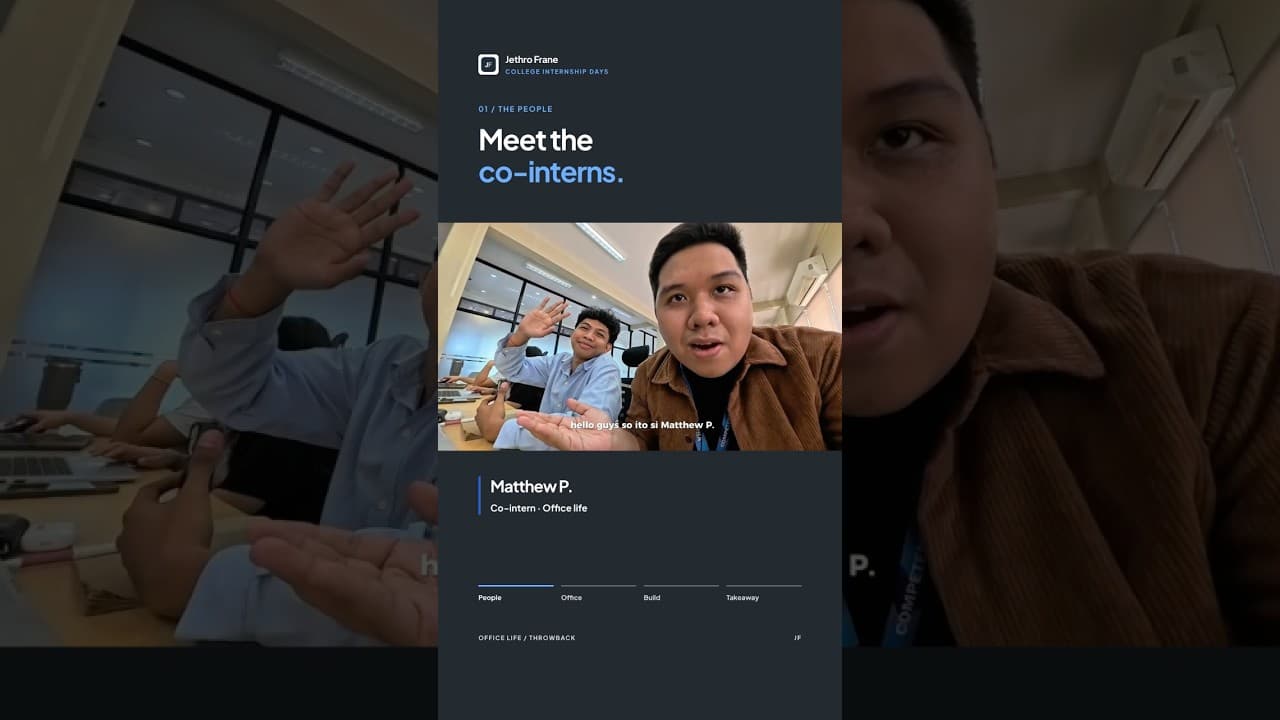
Looking through old project folders recently, I came across the raw vlog footage from my web developer internship in early 2025.
Back then, I was interning at Gencys Digital Trading Inc. while working on Exponential University—a WordPress and BuddyPress community platform. I had an Insta360 Ace Pro 2 running during breaks, office standups, and evening commutes. It was an unfiltered snapshot of what it felt like to be stepping into tech: eager to build, nervous about demos, and constantly absorbing advice from seniors and co-interns.
I decided to revisit that raw footage and edit it into two focused vertical clips using HyperFrames. Watching those moments again reminded me how much of what I practice today in web development and content creation traces back to that room.
Turning raw vlog footage into two short stories
The original recording was a long single take, full of office banter, background noise, and natural pauses. Instead of letting it sit on an external drive, I wanted to turn it into two distinct, structured short-form stories:
- Office life & the JethCommerce demo: A 50-second snapshot showing our morning workspace, talking tech with fellow interns, and the nerve-wracking moment I presented my own storefront project to our team lead.
- Lessons and recognition: A 59-second reflection covering our discussions on frontend styling, an inspiring keynote speech, and our batch celebration at the Exponential U Excellence Awards.
I chose to edit these with HyperFrames—an open-source framework by HeyGen that renders video from HTML and CSS. Instead of manually dragging clips on a timeline in a heavy video editor, I could define exact cuts, chapter overlays, and brand typography (Plus Jakarta Sans on charcoal and cobalt blue) directly in code. For a developer who makes video, being able to compose video timelines like web components felt completely natural.
Presenting JethCommerce: the nerve-wracking demo
One of the clips captures the moment I walked up to our lead’s desk to present a prototype I built called JethCommerce.
It was a personal project—a responsive e-commerce storefront with online customer chat and audio product demos. Walking through my own code in front of an experienced developer was intimidating. My hands were shaking a little, and I was explaining every feature as fast as I could.
That moment taught me something every junior developer eventually learns: you can read tutorials forever, but real confidence comes from building something yourself and letting someone else critique it. Feedback from that demo did not just improve the code; it taught me how to explain technical choices simply and clearly.
Frontend debates and office camaraderie
Another scene in the office clip shows a conversation with my co-intern, Matthew Perlada, as we synced on our WordPress tasks.
At the time, my main toolkit was HTML, CSS, and Bootstrap, with occasional exposure to React and Django. In the video, we were debating the shift toward utility-first styling with Tailwind CSS versus pre-built Bootstrap components. We talked through how Tailwind gave us finer control over spacing and responsiveness, even if it took more classes to write.
Those debates were balanced by genuine office warmth. Later that day, we paused work to surprise our supervisor, Ma\'am Rose Ann, singing happy birthday and sharing food around the desks. Tech work can easily become isolating if you only stare at a terminal, but the camaraderie of that batch made solving tough bugs fun.
Keynote wisdom: "Don't aspire to be number one. Be the only one."
During our awards and keynote ceremony, our speaker shared a thought that stuck with me ever since:
"Programming is creation. The new oil is data... Don't aspire to be number one. Be the only one."
In a fast-moving field, it is easy to get caught up in comparison—wondering if your stack is modern enough, if your GitHub commit graph is green enough, or if someone else is learning faster. That advice helped me reframe my goals. Instead of trying to outcompete everyone at a single skill, I focused on finding my own intersection: building solid web applications, maintaining clean quality-review habits, and producing clear, honest creator content.
Seeing our co-interns recognized that evening—including Rose Ann S. Gito as Top Developer, Kenneth Bryan in QA, Franz Marie in UI/UX, and Franco Miguel in DevOps—showed me what a well-rounded engineering team looks like. Everyone owned their part of the product.
Carrying old lessons into current projects
Returning home on that evening van back to Calamba, Laguna, I remember feeling exhausted but energized.
Today, as I build independent projects like Sonata, Pitch Patrol, and Worship Hub, and document my work through Jethnology, those early internship experiences still serve as my anchor. They taught me that clean code matters, responsive layouts require careful checking on actual devices, and clear communication with your team is just as important as writing the function.
Revisiting those clips through a modern code-driven video workflow was a fun reminder: you never really outgrow the fundamentals you learn on your first real project.
Thanks for reading.Explore Jethnology