AI EXPERIMENT / MUSIC
Pitch Patrol: a small experiment in playing with pitch
· By Jethro Frane · 4 min read
Turning a musical survival-game idea into an open-source browser experiment, using Astra medium for planning, Argon for the prototype, and playtesting to guide the fixes.
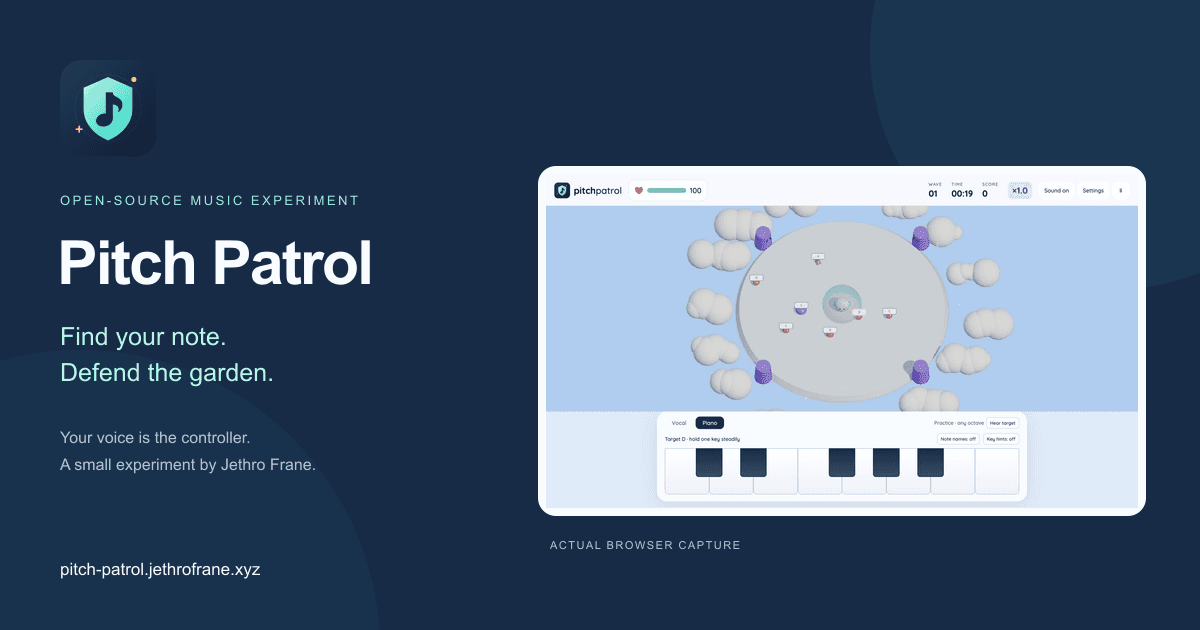
I wanted to try a simple idea: what if your voice could be the controller for a small survival game?
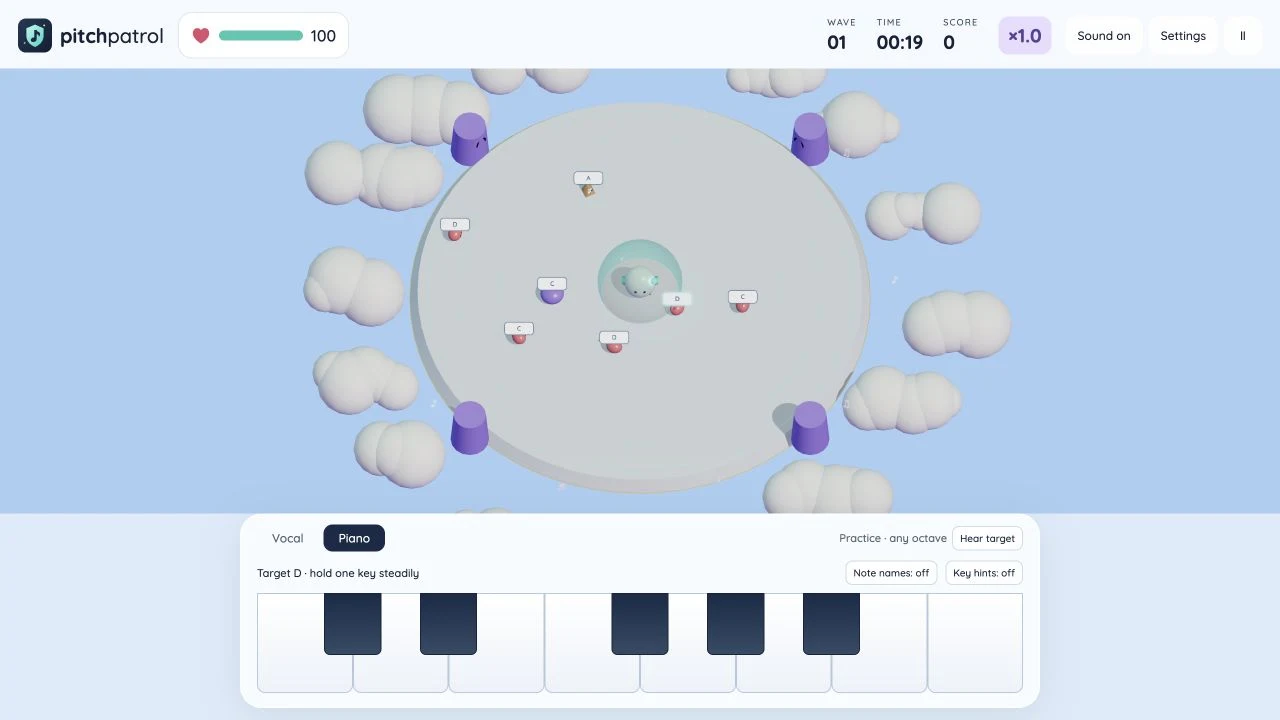
That became Pitch Patrol. Musical creatures approach a guardian in a 3D garden. Hum the note shown above a creature, hold it steadily, and the guardian sends a musical pulse toward it. There is also an on-screen piano for trying the same idea without a microphone.
This is a personal, open-source experiment for pitch-practice testing. I am sharing it as something people can try and inspect, with room for improvement.
One model to plan, another to build
I used Astra at medium effort to develop the brief and Argon in Gemini Tasks to execute the prototype. My part was the concept, the musical direction, and the feedback from trying what came back. Further iterations went through Antigravity, followed by a Codex review and release pass.
This was an experiment in working across AI tools. I did not run a controlled comparison of the models, so I would not treat this project as a benchmark or proof that one model is better.
The first useful feedback came from playing
The early version worked, but some of its behavior defeated the purpose of practice. Random keyboard presses were too easy to reward. The piano controls needed sound. A creature reaching the player ended the run immediately, which made mistakes feel unnecessarily punishing.
I also noticed something harder to describe in a screenshot: the microphone sometimes seemed to become quieter, and notes that sounded correct to me did not always register.
Those observations became specific requests: require a stable note, keep piano and microphone scoring separate, add health, improve note labels, and make the input easier to check.
Listening is part of the interface
The release review found automatic microphone gain enabled in the modular version. That was a plausible contributor to changing levels, but it was not proof of the entire problem. Browser processing, the room, the device, and the detector can all affect the result.
The game now requests automatic gain, noise suppression, and echo cancellation off where supported. Its input panel shows the selected microphone, live signal level, calibration controls, and the settings reported by the browser. If the signal is quiet or unclear, it gives feedback about the input rather than treating every missed note as a musical mistake.
A note must remain sufficiently clear and in tune through a short hold window before it authorizes an attack. Brief dropouts do not earn extra progress. A new attack needs another confirmation window. The piano follows a similar rule and rejects several simultaneous keys as a single-note answer.
A gentler way to try it
Survival starts with 100 health. Creatures have attack cycles, so one mistake does not immediately end the run. Practice mode disables damage and offers a reference tone. That tone temporarily suspends microphone scoring so the game does not reward its own example.
The arena stays top-down. Larger note badges, gradual accidentals, a compact tuner, and touch-friendly piano keys help keep the musical task readable on different screen sizes. Audio analysis stays on the device; the app does not record or upload the microphone audio.
What this release does and does not establish
The release includes automated checks for synthetic pitch signals, noise rejection, matching timing, and health behavior, plus browser layout checks. Those checks help catch implementation errors. They do not establish reliable recognition for every real voice, phone, room, or browser.
Microphone mode currently handles one note at a time. Full piano or guitar chord recognition is not implemented. Any supported octave of the displayed pitch class can match. Scores reflect the game session and settings; they are not a singing assessment or evidence that the game improves musical ability.
Physical mobile microphone testing and broader musical balancing remain useful next steps. For now, I find the result worth trying as a small practice experiment, while keeping those limits visible.
Play Pitch Patrol or read the source and report an issue. Start with headphones and Practice mode, check your input, and hum a comfortable note.
My takeaway from this project is practical: a convincing first build gives me something to test. The useful iteration starts when I can explain exactly where the behavior stops matching the purpose.
Thanks for reading.Explore Jethnology